Rosary Ronin
(ロザリオ浪人)
Written and Illustrated by Mairéad McGuinness
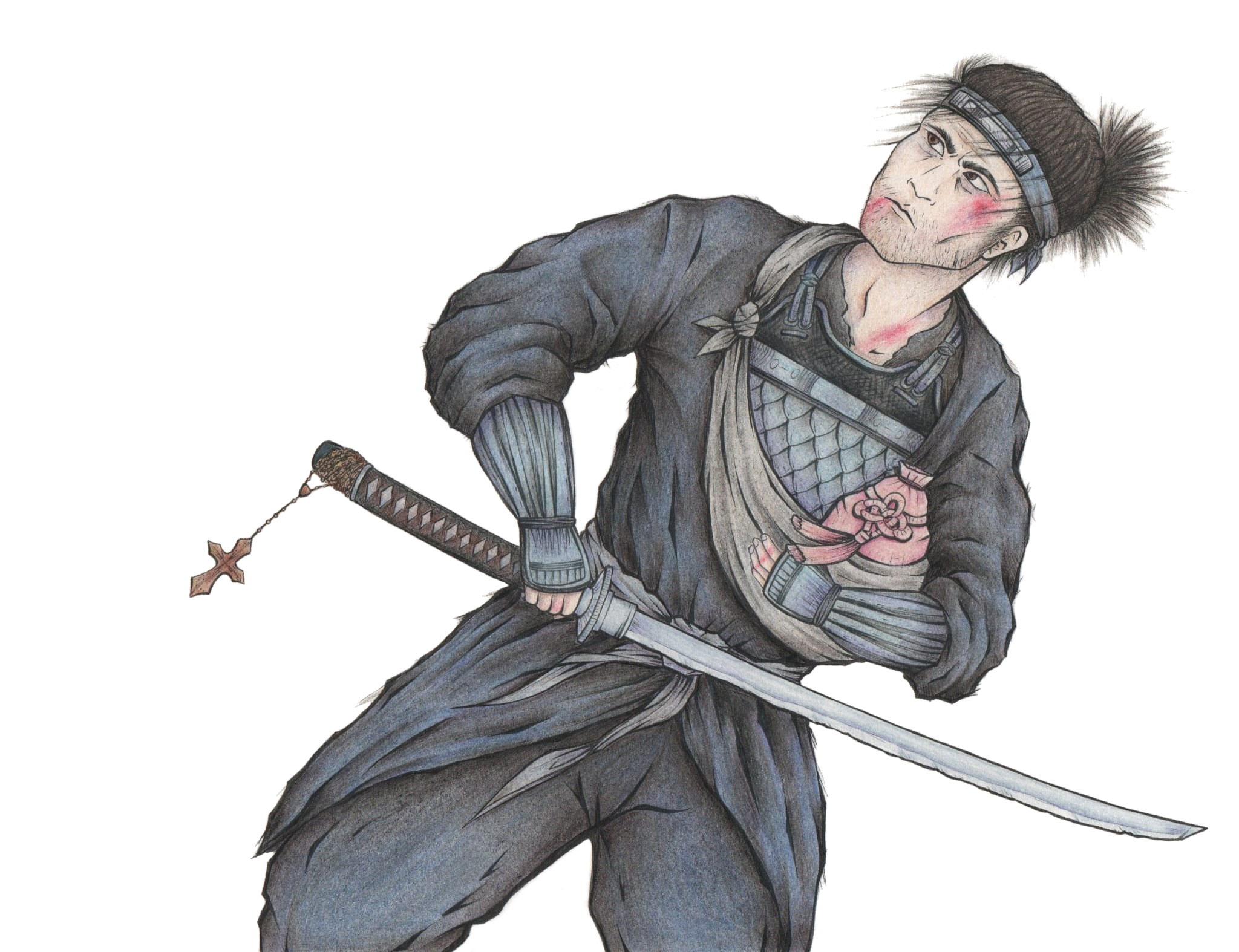
On the narrow path,
Ronin prays with weary stride.
Katana dulled, chipped,
Rosary bound to the hilt—
Pilgrim to sacred summit.

Baptised through fire,
Faith forged from unyielding grief,
Cradles daughter’s urn.
His honour corroded, stained,
Yet Heaven's grace upholds him.

Clan banners surround,
Brothers decree seppuku.
Ronin defies oath —
God above daimyo’s law,
A mortal sin by his creed.

Samurai draw swords.
Cries of treason cleave the air,
Blood‑soaked steel clashes,
Parries, shielding urn from wrath.
Condemned apostate by kin.

Steel tempest subsides,
Armoured bodies lie silent.
One brother still breathes —
Mercy restrains killing blow,
Ronin steps past shrine threshold.

With strained, laboured voice,
He recites Apostles’ Creed.
Battle-worn knees bow,
Mouth bloodied, body writhing.
Grace bears him forth, marches on.

Fog lifts holy peak,
Cherished ashes are offered.
Prayers plead for her soul,
Faith petitions salvation,
Vows to reunite once more.
Author’s Note
This poem is composed in the tanka tradition, a classical Japanese poetic form dating back to the 7th century AD, built on a five‑line, 5‑7‑5‑7‑7 syllabic structure, similar in spirit to a haiku. Here, multiple tanka are linked together to form a continuous narrative, following the Rosary Ronin through his pilgrimage.
Glossary of terms
Ronin — A samurai who has lost his master and lives without a lord.
Katana — A curved, single‑edged Japanese sword traditionally used by samurai.
Rosary — A string of prayer beads used in Christian devotion, especially in Roman Catholicism.
Baptised — A Christian sacrament of initiation in which a person is ritually cleansed with water as a sign of spiritual rebirth.
Pilgrim — A traveler who journeys to a sacred place for religious or spiritual reasons.
Clan (samurai context) — A powerful family group in feudal Japan bound by loyalty, hierarchy, and shared lineage.
Seppuku — A ritual form of suicide historically practised by samurai to preserve honour, associated with Bushidō, the traditional ethical code of the samurai.
Daimyo — A feudal lord in Japan who ruled large territories and commanded samurai retainers.
Mortal sin — In Christian theology, a grave sin that separates a person from God and, if not repented before death, results in eternal separation from Him. Suicide is condemned across Christian tradition.
Samurai — A warrior of Japan’s feudal era bound by a strict code of honour and service.
Apostles’ Creed — A foundational Christian prayer used as a statement of faith, summarising core beliefs about God, Christ, and the Church.
Contact
mmcg_art@outlook.com
Data Protection
Privacy Policy
Terms and Conditions
